Begin with the decision the customer faces
A customer leaves a bicycle at a repair shop and hears that someone will keep them updated. That sounds reassuring, but the customer still cannot decide whether to arrange another way to travel tomorrow. A useful promise starts with the decision waiting on the information. In this example, the customer needs to know when an assessment will arrive and whether any work requires approval.
The distinction is practical. A promise can be friendly and still leave the customer guessing. Before improving its wording, ask what the person will do differently once the promised information arrives. That question gives the message a purpose. It also helps the business avoid sending updates that describe internal activity without answering the customer's actual concern.
Discover the need before choosing the channel
The UK Government Service Manual recommends learning what users are trying to accomplish and treating unsupported assumptions as things to investigate. Its guidance concerns public services, but the underlying research question is useful for a small business: what is the person trying to get done? [1] An email preference and a transport problem are different kinds of information.
For the imagined repair booking, ask whether the customer needs a cost decision, a collection plan, or both. Then ask how they can reliably receive that information. Someone working away from a phone may prefer a message they can read later. Someone with an inaccessible email account may need another arrangement. Choose the channel after establishing the task it must support.
Give the promise four working parts
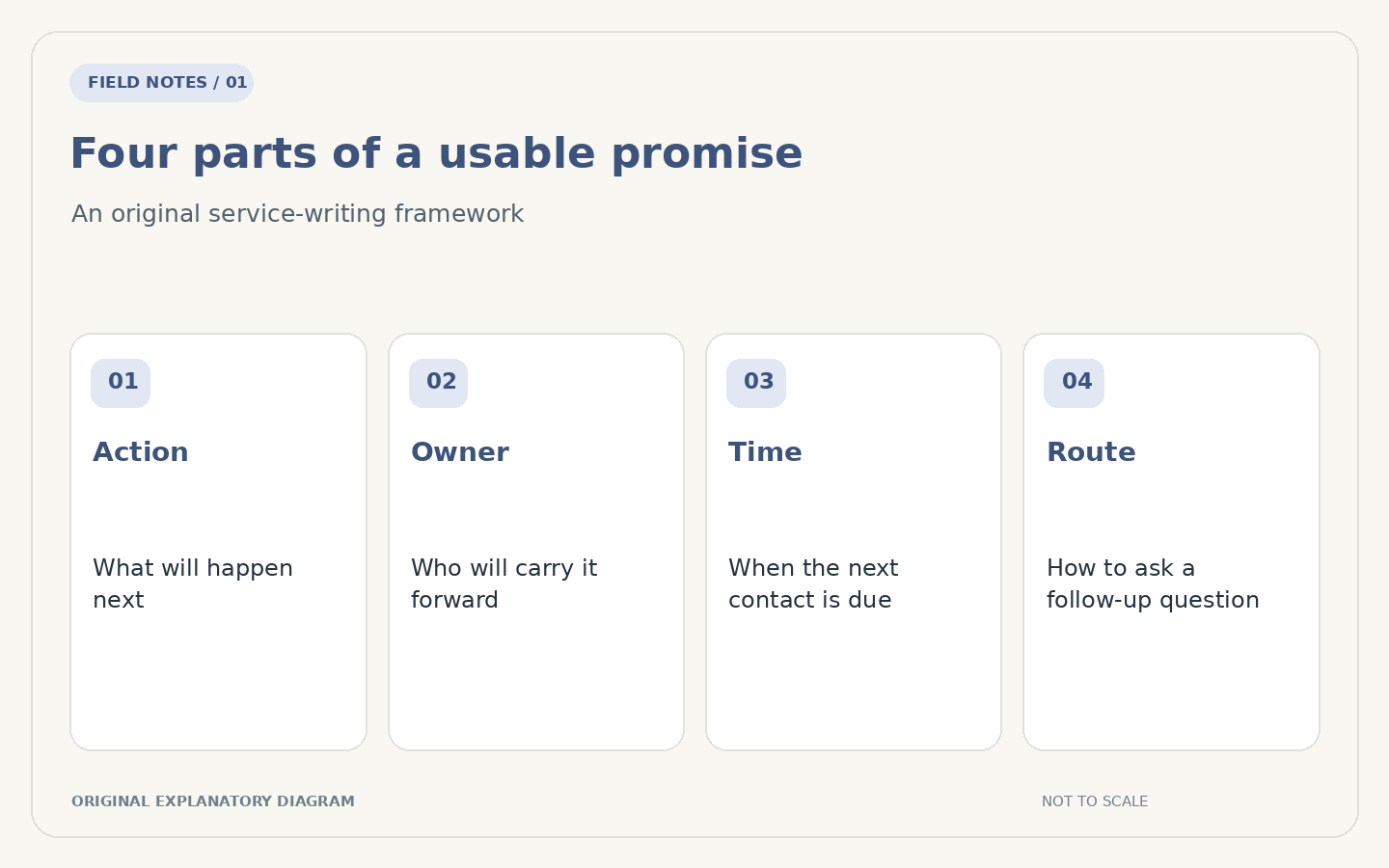
An original way to draft the commitment is to include an action, an owner, a time, and a route for questions. The shop might promise an assessment update from the service desk by an agreed point tomorrow, using the customer's chosen contact method. Those details are proposed wording ingredients, not a universal service standard or a claim that every repair can be completed quickly.
Notice what the promise covers. It concerns the assessment update. It does not quietly guarantee that a replacement part will arrive or that the bicycle will be ready. Keeping the promised event explicit allows staff to be helpful without making an unsupported forecast. The customer can then distinguish between receiving information and receiving the finished service.
Test whether the team can deliver it
A polished sentence is only useful if someone can carry out the action behind it. Follow the commitment through a normal shift change. Can the next staff member find the booking, understand what was promised, and see whether the update has already been sent? If the answer depends on one person's memory, the promise needs an operational home.
For a small team, that home could be an ordinary booking record with a clearly marked next action. Avoid adding a complicated system merely to support a simple sentence. The essential test is whether the responsibility remains visible when the original employee is busy or absent. A customer should not have to repeat the entire conversation to reconstruct an agreement the business already made.
Separate an estimate from a checkpoint
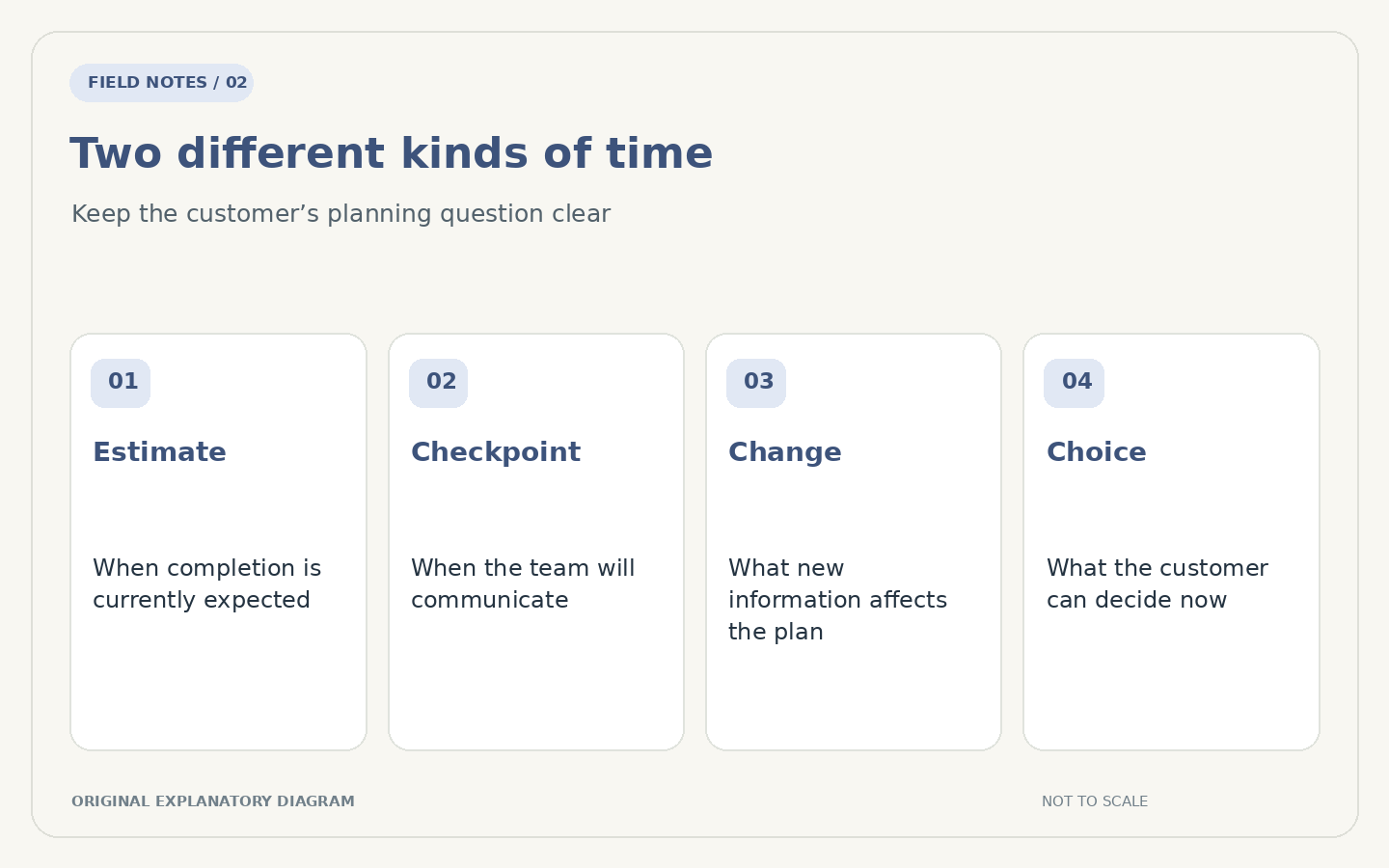
A completion estimate expresses what the team currently expects. A communication checkpoint says when the customer will hear again. In the bicycle example, the shop may be uncertain when an unusual component will become available while still being able to commit to checking its status. State those two kinds of time separately so that an update does not become an accidental completion guarantee.
If the estimate changes, explain what changed and which decision now belongs to the customer. Perhaps the person wants the bicycle returned before a part arrives, or prefers to approve an alternative repair. The useful information is the available choice and its consequence. A long account of telephone calls to suppliers can obscure that choice, even when every detail is true.
Listen for a repeated point of confusion
NIST's customer guidance recommends regular ways of listening to customers and gathering insights from employees who deal with them. It connects that information with decisions about services. [2] A practical application is to notice repeated questions about the same promise. If several people ask whether an assessment fee includes the repair, the phrase may need revision before another message is sent.
Record the question in the customer's ordinary language. A note saying that the customer was confused is less useful than a note identifying the unclear distinction. Keep individual circumstances separate from a repeated wording problem. The aim is to find something the business can change, rather than to collect a list of people who did not understand its preferred terminology.
Try the wording with a fresh reader
Give the proposed message to someone who did not write it and ask what they expect to happen next. Ask who they would contact and whether they think the work has already been authorized. This is a modest rehearsal of the message, not a scientific demonstration that every customer will interpret it identically. Its value lies in exposing assumptions before a real booking depends on them.
Revise the smallest part that caused the misunderstanding, then read the complete message again. An isolated sentence may become clear while contradicting an older sentence below it. Check the subject line, automated confirmation, and spoken explanation together. The customer encounters one service across those surfaces, so a promise should retain the same meaning wherever the person finds it.
Make exceptions understandable
An exceptional situation needs an explicit explanation rather than a silent change in the promise. If the shop cannot inspect the bicycle as planned, name the missed commitment, provide the information currently available, and explain the revised next contact. If the customer has an alternative, make that alternative visible. The message should help the person reorganize their day.
Keep the explanation proportionate. Customers usually do not need personnel details, private information about another booking, or speculation about who is responsible. They do need an honest account of what affects their own decision. Where staff lack authority to offer a remedy, identify who can consider it. That is more useful than repeating an apology without a path forward.
Review the promise after the work ends
When the booking closes, compare the original commitment with what happened. Did the customer receive the promised assessment? Was the next decision clear? Did anyone have to call simply to discover whether an update was still coming? These questions examine the reliability of the promise without requiring a large satisfaction survey or a newly invented performance score.
Choose one improvement for the next booking: a clearer time label, a named team responsibility, or a better explanation of approval. Preserve the parts that already worked. A dependable service promise is a small agreement supported by ordinary working habits. Its strength comes from helping another person plan, and from making the business's next action easy to recognize.
Sources
- Learning about users and their needs — UK Government Digital Service
- Customers: Foundations for a Successful Business — National Institute of Standards and Technology